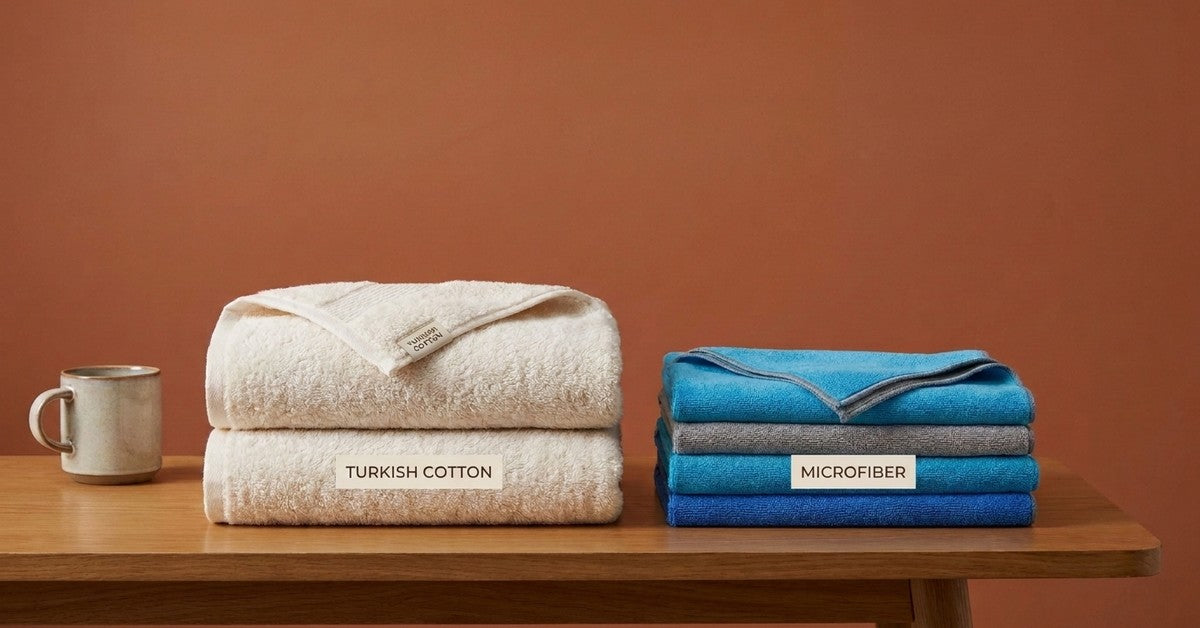
Turkish cotton wins on comfort, durability, and skin feel, while microfiber wins on speed, packability, and price. This guide breaks down the real numbers behind absorbency, odor, longevity, and environmental impact so you can match the right towel to the right situation, whether that is a home bathroom, a gym bag, or a backpacking trip.
Quick Summary
- Best for everyday home use: Turkish cotton (400 to 700 GSM, lasts 5 to 10 years).
- Best for travel and camping: microfiber or a flat weave Turkish peshtemal (dries in 30 to 90 minutes).
- Better raw absorbency per gram: microfiber (holds 7 to 8 times its weight in water).
- Gentler on sensitive or reactive skin: Turkish cotton, according to dermatology guidance on friction and skin barrier care.
- More prone to odor and microplastic shedding: microfiber, confirmed by federal environmental and waste data cited below.
What Is the Real Difference Between Turkish Cotton and Microfiber Towels?
Turkish cotton is a natural plant fiber grown mainly in the Aegean region of Turkey, spun from extra long staple yarn that softens with every wash. Microfiber is a synthetic fabric built from split polyester and polyamide strands, engineered in a factory rather than grown on a plant.
The two materials behave almost like opposites in daily use. Cotton is heavier, plusher, and slower to dry, while microfiber is lighter, thinner, and dries in a fraction of the time. The table below lays out the full comparison side by side.
| Feature | Turkish Cotton Towels | Split Microfiber Towels |
|---|---|---|
| Material base | 100% Aegean extra long staple (ELS) cotton | 80% polyester / 20% polyamide blend |
| Weight (GSM) | 400 to 700 GSM | 150 to 300 GSM |
| Drying time (indoor air) | 2 to 4 hours | 30 to 60 minutes |
| Packed volume | About 3.5 to 5 liters of bag space | Compresses to under 0.8 liters |
| Longevity | 5 to 10+ years with proper laundering | 1 to 2 years before oil buildup or static wear |
| Skin feel | Plush, smooth glide, low friction | High friction, catchy grip, static prone |
| Best used for | Everyday home bath, guest suites, spas | Backpacking, gym bags, camping, travel |
Which Towel Absorbs Water Better, Turkish Cotton or Microfiber?
Microfiber absorbs more water relative to its own weight, holding roughly 7 to 8 times its dry weight in moisture, compared with about 3 to 4 times for Turkish cotton. Despite that, most people report a better drying experience on skin with Turkish cotton, because natural cellulose fiber pulls moisture away without the dragging sensation microfiber can produce.
Turkish cotton is spun into flat, open loops that release moisture gradually rather than trapping it, which is part of why it resists the musty smell that develops in a closed bathroom. Microfiber is mechanically split during manufacturing into microscopic channels that draw liquid in fast through capillary action, but those same channels also trap body oil alongside the water.
What Problems Should You Expect From Microfiber Towels?
The most common microfiber towel problems are skin drag on dry skin, permanent oil and odor retention, static cling, and measurable shedding of plastic microfibers during washing. Each of these issues traces back to the same root cause: microfiber is a petroleum based synthetic, not a natural fiber.
- Skin drag: the split fiber structure that makes microfiber so absorbent also lets it catch on dry cuticles, calluses, and facial hair.
- Static and debris attraction: polyester builds an electrostatic charge that pulls in pet hair, dust, and lint from hampers and floors.
- Microplastic shedding: the NOAA Marine Debris Program reports that in a survey of 37 national park beaches, plastic fibers from sources like synthetic clothing and towels made up 97 percent of all microplastic debris found. Separate federal waste data from the US EPA shows more than 11 million tons of textile waste, including towels, were landfilled in a single recent reporting year.
- Heat sensitivity: polyester softens and degrades above about 140°F (60°C). The US Consumer Product Safety Commission regulates flammability standards for household textiles, and synthetic lint is also flagged in CPSC dryer safety research as more heat reactive than natural fiber lint, which is one reason high heat drying is discouraged for microfiber.
Why Do Microfiber Towels Smell Like Mildew or Body Odor Over Time?
Microfiber towels develop a sour, lingering smell because polyester is naturally oil attracting, so it bonds chemically to body oils that a standard cold water wash cannot fully remove. Those trapped oils then feed the same bacteria responsible for ordinary human body odor.
Research summarized by the National Institutes of Health on the human skin microbiome shows that Staphylococcus and Corynebacterium bacteria naturally colonize warm, moist areas of the body and are the organisms most responsible for breaking sweat and oil down into odor causing compounds. When those bacteria and oils get trapped in the microscopic channels of microfiber, the smell becomes very difficult to fully rinse out. Cotton, being naturally oil releasing, tends to shed those same oils far more easily in a normal warm water wash. If your towels already smell musty, our guide to removing stubborn mildew smell and our step by step vinegar and baking soda wash method both walk through the exact soak and wash routine that strips grease buildup without damaging the fibers.
- Soak the towel in warm water with 1 cup of distilled white vinegar for 45 minutes to dissolve detergent residue.
- Machine wash with a fragrance free liquid detergent plus half a cup of baking soda.
- Skip fabric softener entirely, since it coats fibers in a silicone layer that locks bacteria in rather than releasing them.
Which Towel Is Best for Travel, Camping, or a Carry On Bag?
Microfiber is the better travel towel for backpackers, campers, and carry on minimalists because of its light weight, small packed size, and fast drying time. A standard 30 by 60 inch microfiber travel towel weighs about 7 to 9 ounces (200 to 250 grams) and compresses to roughly the size of a soda can.
A comparable full size Turkish terry towel weighs 20 to 28 ounces (570 to 800 grams) and takes up several times the bag space. If you like the feel of natural cotton but still need portability, a traditional flat weave Turkish towel, often called a peshtemal, is a strong middle ground: it packs to about one third the size of a standard bath towel and air dries in roughly 90 minutes. See our full breakdown of how Turkish fiber compares with other premium cottons in this guide to Turkish versus Egyptian cotton.
Is Microfiber Bad for Sensitive Skin or Hair?
Microfiber is not toxic, but its aggressive mechanical grip can irritate sensitive, acne prone, or eczema affected skin. Because the split fibers are designed to pull oil and fine particles off a surface, patting a reactive face with microfiber can strip the natural lipid barrier and tug on delicate skin cells.
Turkish cotton's continuous, uncut loops glide across the skin with far less surface friction, which is why most dermatology focused guidance favors natural fiber towels for reactive or compromised skin. For a deeper breakdown of which materials and weaves suit different skin types, see our guide to the best bath towels for sensitive skin. On hair, fine microfiber wraps do wick moisture quickly, but textured, curly, or color treated hair usually benefits more from a smooth cotton or waffle weave Turkish towel that will not snag the hair cuticle.
How Should You Wash Each Towel Type So It Lasts Longer?
Wash Turkish cotton in warm water around 105°F (40°C) with a standard liquid detergent and skip the fabric softener, since softener coats the yarn in a water repelling layer that reduces absorbency. Wash microfiber separately in cool water on a gentle cycle to protect the split fiber structure.
- Never wash microfiber and cotton in the same load, since shedding cotton lint clogs the microscopic channels that give microfiber its absorbency.
- Tumble dry Turkish cotton on medium heat, or hang it to dry, since it naturally softens with every wash as the long staple fibers loosen. If your towels have gone stiff or scratchy, see our guide on how to make towels soft again for a full reset routine.
- Air dry or use only the lowest heat setting for microfiber, since heat above roughly 140°F (60°C) permanently damages its capillary structure.
What GSM Should You Look for in a Turkish Cotton Towel?
Aim for 500 to 600 GSM (grams per square meter) for the best balance of plush comfort and reasonable drying speed. Towels under 450 GSM are thin and better suited for the beach or packing, while towels above 700 GSM feel luxurious but can take so long to dry indoors that they risk developing a musty smell in a humid bathroom.
GSM is a measurement of fabric density, not a marketing term, and it directly predicts how a towel will feel, absorb, and dry. For a complete walkthrough of what the number means and how to choose the right weight for your climate, read our full GSM explainer.
How Can You Tell If a Towel's Cotton Claim Is Actually Accurate?
Check the sewn in fiber content label, because federal law requires it to state the exact percentage of every fiber by weight. Under the FTC Textile Fiber Products Identification Act, any towel sold in the United States must carry a label disclosing its generic fiber names and their percentages, so a towel marketed as Turkish cotton but blended with polyester filler is legally required to say so on the tag.
Fiber length claims can also be checked against an independent standard. The USDA Agricultural Marketing Service grades every bale of cotton produced in the country against official extra long staple and upland grade standards, which is the same classification system that defines genuine ELS cotton used in premium Turkish and Pima toweling.
Which Towel Should You Actually Buy?
If you only buy one towel, match it to how you will actually use it rather than to which material sounds more premium. The recommendations below cover the most common situations.
- Everyday home bathroom: choose a 500 to 600 GSM Turkish cotton bath towel for the best mix of softness, absorbency, and lifespan. Browse our Turkish towels collection to compare weights and weaves.
- Guest suites or full household restocking: a matched towel set keeps bath, hand, and face towels consistent in GSM and color.
- Travel, gym bags, and camping: a lightweight microfiber towel or a flat weave Turkish peshtemal will pack smaller and dry faster than a terry towel.
- Spa style routines at home: pair a Turkish cotton towel with accessories from our spa and hamam accessories collection for a full hamam style ritual.
- Not sure where to start: our top sellers collection reflects what most customers choose across GSM weights and price points.
Sources
Every government and research source referenced in this article is linked below so you can verify the figures directly.
- NOAA Marine Debris Program, Microplastics — federal data on fiber pollution from synthetic textiles.
- US EPA, Textiles: Material Specific Data — federal municipal solid waste data on textile disposal.
- USDA Agricultural Marketing Service, Cotton Classing Services — official federal cotton grading and staple length standards.
- Federal Trade Commission, Textile Fiber Products Identification Act — federal labeling law for fiber content disclosure.
- National Institutes of Health, National Library of Medicine, The Skin Microbiome — peer reviewed research on skin bacteria and odor formation.
- US Consumer Product Safety Commission, Flammable Fabrics Act — federal flammability and heat safety standards for textiles.
"
"