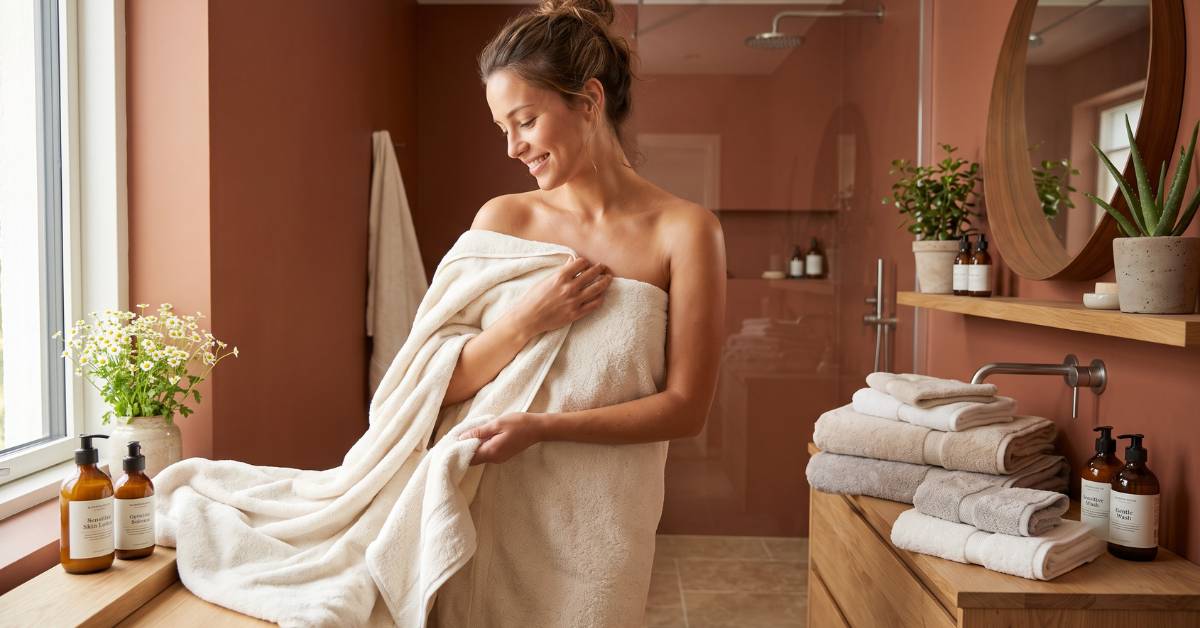
Stepping out of a warm shower should feel like relief, not the beginning of a skin battle. Yet for the 31.6 million Americans living with some form of eczema, and the estimated 16 million Americans dealing with rosacea, the wrong towel can undo everything a careful skincare routine has worked to achieve. Globally, the picture is even larger: eczema affects between 10–20% of children and 2–10% of adults worldwide, making reactive skin one of the most common daily health challenges on the planet.
When your skin barrier is already compromised, rubbing it with the wrong fabric is not just uncomfortable, it can cause micro-abrasions, redness, and itching that worsens your condition. For people with sensitive skin, a towel is quite literally a skincare tool.
The good news? The global bath towel market will hit $11.8 billion in 2025 and is expanding rapidly, with premium, hypoallergenic, and sustainable options now more accessible than ever—whether you're shopping in Chicago, London, Sydney, or Tokyo. Finding the right towel is about understanding fiber structure, weave, certifications, and proper care. This guide gives you everything you need, backed by clinical research.
Who This Guide Is For
This guide is for anyone who experiences:
- Atopic dermatitis (eczema) — affecting 7.6% of U.S. adults and 12.7% of U.S. children as of 2024, per the National Health Interview Survey
- Rosacea — affecting approximately 16 million Americans and 5% of adults globally (JAAD, 2024)
- Contact dermatitis or general skin sensitivity triggered by fabrics, dyes, or detergents
- Psoriasis, dry skin, or any condition that leaves the skin barrier fragile or reactive
Whether you're based in the U.S. or anywhere in the world, the advice in this guide applies. Where product certifications differ by region, we've noted the relevant global equivalents.
What Is the Best Towel Material for Sensitive Skin?
The best materials for sensitive skin are long-staple cottons (Turkish and Egyptian) and bamboo viscose. To understand why, you first need to understand what goes wrong with the wrong fabric.
Standard, budget-friendly cotton towels—the kind found in most big-box stores across the U.S. and discount retailers globally—are made from short-staple cotton. These fibers have multiple exposed ends. With repeated washing, those ends fray, pill, and stiffen. Dragging that rough surface across reactive skin creates what dermatologists call mechanical friction—microscopic trauma that irritates nerve endings, disrupts the skin's lipid barrier, and in people with eczema, directly triggers inflammatory flare-ups.
Long-staple cottons and bamboo viscose, by contrast, use continuous, unbroken threads that stay smooth wash after wash. Paired with the right safety certifications (see below), they represent the safest daily contact fabric for compromised skin.
The American Academy of Dermatology (AAD) specifically recommends using 100% cotton towels and sheets as a standard part of eczema self-care, noting that this choice can meaningfully reduce flare-ups.
The Most Important Certification to Look For
Before buying any towel for sensitive skin, look for the OEKO-TEX Standard 100 label. This globally recognized certification—honored in the U.S., EU, UK, Australia, Canada, and most other markets—guarantees that every component of the towel, from the threads to the dyes to the finishing chemicals, has been independently tested and is free from hundreds of harmful substances known to cause skin reactions, including allergenic dyes and formaldehyde resins.
A step further is the GOTS (Global Organic Textile Standard) certification, which verifies that cotton was grown organically—without synthetic pesticides or fertilizers—and processed with non-toxic dyes. For the most reactive skin types, GOTS-certified towels provide maximum assurance.
Where to find them: OEKO-TEX and GOTS certified products are widely available across the U.S. (Amazon, Target, Walmart, specialty home goods retailers), Europe (John Lewis, Zara Home, H&M Home), Australia, and through global direct-to-consumer brands. Always check the label—not all brands that claim to be soft or hypoallergenic have the certification to back it up.

Towel Material Deep-Dive: Which Is Right for You?
Turkish Cotton — Best All-Around for Sensitive Skin
Thirsty Towels' Turkish Towels collection is built around this material, and for good reason. Turkish cotton is grown primarily in the Aegean region of Turkey and is characterized by its exceptionally long fiber staple. Those long, unbroken threads are spun into yarns that are finer, stronger, and dramatically softer than standard cotton.
What makes Turkish cotton particularly well-suited for sensitive skin is its drying speed. Because Turkish cotton is woven with a slightly looser, lighter structure than Egyptian cotton, it dries out in 30–50% less time. In humid bathroom environments—a reality for most households across the U.S. South, Southeast Asia, the UK, and Australia—faster drying means less bacterial and mold growth between uses. For eczema-prone skin, this matters enormously: reusing a damp, bacteria-laden towel on compromised skin is one of the most reliable ways to trigger a flare.
Turkish cotton also gets noticeably softer with every wash, making it a long-term investment in skin comfort.
Egyptian Cotton — Best for Dry Climates and Maximum Plushness
Egyptian cotton is among the world's most premium textile materials. Its extra-long staple fibers produce a dense, heavy, ultra-absorbent weave that many people describe as the closest thing to a luxury spa experience at home.
However, its density is also its limitation for sensitive skin in humid environments. Egyptian cotton towels retain moisture for extended periods—sometimes 4–6 hours in a poorly ventilated bathroom. That prolonged dampness becomes a breeding ground for bacteria and yeast, both of which can aggravate eczema and cause folliculitis (inflammation of the hair follicles).
If you live in a dry climate—Phoenix, Denver, inland Australia, the Middle East, or Mediterranean Europe—Egyptian cotton is an excellent choice. If you're in a humid coastal city or a bathroom without strong ventilation, Turkish cotton is the safer pick.
Bamboo Viscose — Best for Very Reactive or Eczema-Prone Skin
Bamboo viscose is arguably the most skin-friendly fabric available for towels. Its fibers are naturally smooth and rounded at the microscopic level, lacking the sharp edges found in standard cotton. Against sensitive, inflamed, or flaking skin, bamboo simply glides—there is no catching, no dragging.
It is also:
- Naturally hypoallergenic — no added chemicals required
- Mildly antimicrobial — bamboo contains a natural bio-agent (bamboo kun) that resists bacterial and mold growth
- Highly absorbent — bamboo absorbs up to three times its weight in water, meaning you can pat dry with minimal effort rather than rubbing
The National Eczema Society lists bamboo among the top recommended fabrics for eczema-prone skin, citing its breathability (20% higher than cotton) and absorption capacity (60% greater than standard cotton).
Microfiber — Use With Caution
Microfiber is a synthetic blend (typically polyester and polyamide) engineered to grip and trap particles. That engineering is fantastic for cleaning surfaces and drying hair—but problematic for reactive skin on a body. Under a microscope, microfiber threads look like tiny asterisks or hooks. On healthy skin, this is barely noticeable. On skin with dry, flaking patches, psoriasis, or eczema, those hooks catch on uneven skin surfaces and create a dragging sensation that many find intensely uncomfortable.
If you use microfiber, the rule is: press, never rub. Let the towel absorb moisture passively rather than wiping it across your skin. For regular full-body drying, long-staple cotton or bamboo is the significantly better choice.
Full Material Comparison Table
| Material | Fiber Type | Softness | Absorbency | Drying Speed | Eczema-Friendly | Best Climate |
|---|---|---|---|---|---|---|
| Turkish Cotton | Natural, long-staple | ★★★★★ | ★★★★ | Fast | ✅ Excellent | All, especially humid |
| Egyptian Cotton | Natural, extra-long staple | ★★★★★ | ★★★★★ | Slow | ✅ Very Good | Dry climates |
| Bamboo Viscose | Natural-derived | ★★★★★ | ★★★★★ | Medium-Fast | ✅ Excellent | All climates |
| Organic Cotton | Natural, short-medium staple | ★★★★ | ★★★★ | Medium | ✅ Good | All climates |
| Microfiber | Synthetic | ★★★ | ★★★★★ | Very Fast | ⚠️ Caution | Any |
| Standard Cotton | Natural, short-staple | ★★★ | ★★★ | Medium | ❌ Not Ideal | — |
| Synthetic Blends | Polyester/Nylon | ★★ | ★★ | Fast | ❌ Avoid | — |
Understanding GSM: The Number That Actually Matters
GSM stands for Grams per Square Meter and measures towel density—effectively how thick, heavy, and plush it is. It is widely used across the U.S., Europe, Australia, and global markets as the standard indicator of towel quality.
| GSM Range | Feel & Weight | Dry Time | Sensitive Skin Note |
|---|---|---|---|
| 300–400 GSM | Lightweight, thin | Very fast | Good for humid climates; less plush |
| 400–600 GSM | Medium weight, balanced | Moderate | ✅ Sweet spot for sensitive skin |
| 600–900 GSM | Heavy, spa-plush | Slow | Risk of retaining moisture too long in humid bathrooms |
For most people with eczema or rosacea, 400–600 GSM hits the ideal balance: plush enough to be gentle on the skin, light enough to dry between uses and discourage bacterial growth.
🌿 Brand Recommendation:
For sensitive skin shoppers, Thirsty Towels is worth a close look. Two collections stand out:
Turkish Towels Collection — Made from long-staple Turkish cotton, these towels get softer with every wash, dry quickly to prevent bacterial buildup, and are ideal for everyday use on reactive skin. Whether you're dealing with eczema flares, post-shower rosacea redness, or just chronically dry skin, the fiber quality here reduces the friction most standard towels create.
Bathrobes Collection — For people who find towel-drying particularly uncomfortable during a flare-up, wrapping yourself in a soft bathrobe and allowing moisture to absorb passively—no rubbing, no dragging—is one of the gentlest drying methods available. This is especially useful for children with eczema or adults experiencing widespread skin irritation.
How to Dry Off Properly: The Technique Matters as Much as the Towel
Choosing the right towel is only half the equation. The way you use it determines whether your skin stays calm or inflames.
The golden rule: Pat, never rub.
Vigorous rubbing creates mechanical friction. For anyone with rosacea, this friction immediately triggers vasodilation—increased blood flow to the skin surface, producing visible redness and a burning sensation. For eczema, it physically disrupts the outermost epidermis and can turn a manageable situation into a full flare.
The NIH's published clinical guidance on eczema management is explicit: after bathing, patients should gently towel dry before applying emollients to slightly damp skin, a technique that supports the skin barrier and minimizes dryness.
The AAD's atopic dermatitis self-care guidelines align with this: pat skin partially dry, then immediately apply moisturizer while skin is still slightly damp to lock in moisture.
The correct drying technique:
- Wrap the towel around your body or drape it over damp skin—don't wipe.
- Use flat, open palms to press the fabric gently into your skin in sections.
- Allow the towel's capillary action to pull moisture away naturally.
- Stop when skin is still slightly damp—this is the ideal moment to apply your emollient or moisturizer.
The NHS guidance on emollients reinforces this: emollients should be smoothed, not rubbed into skin in the direction of hair growth, applied immediately post-bathing to damp skin.
For full-body drying with zero friction, slipping into a soft robe from Thirsty Towels' Bathrobes collection lets moisture absorb passively—ideal during flare-ups when even gentle patting feels too rough.
How Often Should You Change Your Towel?
If you have sensitive skin: every 2–3 uses, maximum.
Every time you dry off, you transfer dead skin cells, body oils, and moisture into the towel fibers. That combination creates a warm, damp incubator for bacteria and yeast. Reusing that towel on compromised skin is one of the most consistent ways to trigger folliculitis, body acne, or an eczema flare.
The WHO's hygiene guidance advises against reusing or sharing towels, particularly in the context of skin health and infection prevention—advice that is even more relevant for those with reactive or broken skin barriers.
Always hang your towel spread completely flat on a horizontal bar, not bunched on a hook. The goal is maximum airflow so it dries thoroughly between every use.
Washing Your Towels: The Right Way for Sensitive Skin
Buying a high-quality towel is only half the job. Washing it incorrectly can layer the fabric with chemicals that irritate skin just as much as a scratchy weave would.
Choose the Right Detergent
Always use a "Free and Clear" liquid detergent—100% free of synthetic fragrances, optical brighteners, and dyes. This advice is consistent across major health organizations:
- The AAD recommends fragrance-free, dye-free laundry detergent for all fabrics that touch eczema-prone skin.
- The National Eczema Association (NEA) endorses specific fragrance-free detergents as safe for eczema and sensitive skin.
Why liquid over powder? Powder detergents can fail to dissolve fully in high-efficiency (HE) washing machines—a standard found across the U.S., EU, Australia, and most developed markets—leaving alkaline grit trapped in the towel's fibers. Liquid detergent rinses out far more cleanly.
Use half the recommended amount. Over-soaping leaves a stiff, soapy residue on the fabric. Run an extra rinse cycle to flush out any remaining detergent.
Never Use Fabric Softener
This cannot be overstated: fabric softener and dryer sheets are among the most common towel-related causes of allergic contact dermatitis.
They don't actually soften cotton fibers. Instead, they coat them in a waxy, silicone-based residue packed with synthetic fragrances and phthalates—chemicals documented as contact allergen triggers in peer-reviewed dermatology research. When you dry off with a fabric-softener-coated towel, you're rubbing those chemicals directly into freshly washed, open pores.
On top of the irritation risk, fabric softener destroys absorbency. A towel coated in silicone residue can no longer effectively pull moisture from skin—defeating its entire purpose.
The AAD's child eczema self-care guide specifically notes that scented fabric softeners and dryer sheets may contribute to irritation and should be avoided.
The natural alternative: Add ½ cup of distilled white vinegar to the rinse cycle. It strips trapped soap scum from the fibers, leaving towels naturally soft and fluffy. The smell disappears completely in the dryer.
Full Towel Care Reference Table
| Step | What to Do | Why It Matters |
|---|---|---|
| Before first use | Wash before using | Removes manufacturing residues, dyes, and finishing chemicals |
| Detergent type | "Free and Clear" liquid | No fragrance, dyes, or optical brighteners |
| Detergent amount | Use half the stated dose | Prevents soapy residue buildup in fibers |
| Rinse cycle | Run an extra rinse | Ensures full detergent removal |
| Fabric softener | Never use | Coats fibers with irritants; destroys absorbency |
| Natural softener | ½ cup white vinegar in rinse | Strips soap scum; leaves fibers naturally fluffy |
| Drying temperature | Low or medium heat | Preserves fiber integrity and softness |
| Storage between uses | Spread flat on a bar | Allows thorough drying; prevents bacteria and mold |
| Replacement frequency | Every 2–3 uses | Prevents bacterial buildup on compromised skin |
| When to replace | When stiff, rough, or worn | Old towels lose their soft fiber surface |
Climate & Regional Considerations: A Global Perspective
Sensitive skin doesn't behave the same everywhere. Here's how regional climate affects your towel choice:
| Region / Climate | Challenge | Best Towel Type |
|---|---|---|
| U.S. Southeast, Gulf Coast | High humidity year-round | Turkish cotton (fast-drying); bamboo viscose |
| U.S. Southwest (Arizona, Nevada) | Dry heat; skin dries out quickly | Egyptian or Turkish cotton, higher GSM |
| U.S. Northeast (humid summers) | Seasonal humidity fluctuation | Turkish cotton for summer; Egyptian for winter |
| UK, Northern Europe | Cool, damp; slow-drying bathrooms | Turkish cotton or bamboo; critical to hang flat |
| Southeast Asia, South Asia | Tropical humidity; mold risk | Bamboo viscose (antimicrobial); fast-drying towels |
| Australia (coastal cities) | High humidity (Sydney, Brisbane) | Turkish cotton; 400–500 GSM sweet spot |
| Middle East, North Africa | Dry heat; central air conditioning | Egyptian cotton; higher GSM acceptable |
| East Asia (Japan, Korea) | Humid summers; quality-conscious market | Bamboo viscose; OEKO-TEX certified preferred |
Sources & References
- American Academy of Dermatology (AAD) — Atopic Dermatitis Skin Care Tips: https://www.aad.org/public/diseases/eczema/types/atopic-dermatitis/atopic-dermatitis-coping
- American Academy of Dermatology (AAD) — Atopic Dermatitis Self-Care (Children): https://www.aad.org/public/diseases/eczema/types/atopic-dermatitis/self-care
- NHS (UK) — Emollients: Application and Skin Care Guidance: https://www.nhs.uk/tests-and-treatments/emollients/
- National Eczema Society (UK) — Clothing and Eczema: https://eczema.org/information-and-advice/triggers-for-eczema/clothing-and-eczema/
- NIH / PMC — Update on the Management of Chronic Eczema (Post-bathing emollient and gentle towel drying guidance): https://pmc.ncbi.nlm.nih.gov/articles/PMC3047944/
- NIH / PMC — Hand Hygiene Practices and Risk of Hand Eczema (WHO towel reuse guidance): https://pmc.ncbi.nlm.nih.gov/articles/PMC7413445/
- NIH / PMC — Fragrance Allergic Contact Dermatitis (The Atomizer Sign): https://pmc.ncbi.nlm.nih.gov/articles/PMC8337024/
- National Eczema Association (NEA) — Eczema Facts & Statistics (31.6 million Americans): https://nationaleczema.org/research/eczema-facts/
- Journal of the American Academy of Dermatology (JAAD) — Prevalence of Atopic Dermatitis in the U.S. 2021–2024: https://www.sciencedirect.com/science/article/pii/S0190962225029731
- Journal of the American Academy of Dermatology (JAAD) — Epidemiology of Acne and Rosacea: A Worldwide Global Study (2024): https://www.jaad.org/article/S0190-9622(24)00002-1/fulltext
- Global Market Insights — Bath Towel Market Size & Forecast 2025–2035: https://www.gminsights.com/industry-analysis/bath-towel-market
- National Rosacea Society (NRS) — Rosacea Prevalence in the United States: https://www.rosacea.org/tags/prevalence