Updated guide, checked against cotton industry data and current U.S. government textile and consumer guidance. Every claim below is backed by a linked source at the end of this article.
What Is the Quick Answer?
A brand new Turkish towel feels stiff and sheds water instead of soaking it up because of two ordinary manufacturing steps, a starch or wax finish called sizing and tight weaving tension, not because the towel is faulty. Both conditions disappear once you wash the towel the right way, and the cotton keeps getting softer for years afterward.
- Cause: factory sizing (starch, wax, or silicone finish) plus high weave tension keeps the cotton fibers flat and closed.
- Fix: soak in plain cold water for twelve to twenty four hours, then run one gentle cold wash with no fabric softener.
- Timeline: flat woven peshtemal towels soften in about two to three washes; thicker terry loop towels take five to ten washes.
- Avoid: liquid fabric softener and dryer sheets, which coat cotton fibers in a water repellent film that lowers absorbency over time [EPA].
- Booster: about half a cup of white vinegar in the rinse cycle helps strip sizing and mineral deposits without sealing the fibers [EPA].
What Does This Guide Cover?
- Why new Turkish towels are stiff and not absorbent
- What towel bloom is and how the fibers change
- What actually causes the stiffness
- How to complete a proper first wash
- How many washes it takes to soften a towel
- Whether fabric softener ruins Turkish towels
- Vinegar compared with fabric softener, side by side
- Which towel weave softens the fastest
- How to care for Turkish towels for years
- Frequently asked questions and full source list
Why Are New Turkish Towels Stiff and Not Absorbent?
New Turkish towels are stiff and slow to absorb water because textile mills coat the yarn in a protective finish called sizing before weaving, and because the fabric is woven under high tension to hold a crisp pattern. Neither issue is a defect. It simply means the long staple Aegean cotton has not yet been through a home wash cycle.
Authentic Turkish towels are woven from long staple cotton, which produces longer and smoother threads with fewer exposed fiber ends than shorter staple cotton. The United States Department of Agriculture tracks fiber length as one of the core measures of cotton quality, and longer staple cotton is consistently associated with stronger, finer, and more absorbent finished fabric [USDA]. If you are comparing fiber types, our guide on Turkish versus Egyptian cotton breaks down how staple length affects softness and price.
What Is Towel Bloom and How Does It Work?
Towel bloom is the process in which long staple cotton fibers absorb water, swell, and relax across repeated wash cycles, turning a flat and stiff weave into a thick and plush one. It happens because water gradually releases the tension and finish applied during manufacturing, so individual fibers can open outward and increase their surface area.
- Stage one: compressed factory threads, coated in sizing, under full loom tension.
- Stage two: water exposure during the first soak begins dissolving the sizing.
- Stage three: washing agitates and rinses away the loosened starch and residue.
- Stage four: drying sets the fibers in their newly relaxed, expanded position.
- Stage five: repeated cycles compound the effect until the towel reaches full bloom.
Unlike short staple cotton, which can fray or break down with repeated laundering, long staple Aegean cotton untwists slightly without losing strength, which is why quality Turkish towels keep improving with age instead of wearing out.
What Actually Causes the Stiffness? Sizing and Weave Tension Explained
Two manufacturing steps cause the initial stiffness: a starch or synthetic sizing finish applied to the yarn, and tight tension on the loom that compresses the weave. Both protect the towel during production and shipping, and both wash out once you launder the towel at home.
Sizing is a temporary coating, often a starch, wax, or silicone based polymer, applied to warp yarns so they can survive the friction of high speed looms without snapping. Government reviews of chemical textile finishes note that consumer products, including textiles, can carry residual finishing chemicals that are meant to wash out during normal laundering rather than remain on the fabric [CPSC]. Reputable brands disclose fiber content accurately under federal labeling rules, so checking the label is also a quick way to confirm you bought genuine cotton rather than a synthetic blend [FTC]. For a broader troubleshooting checklist, see our guide on how to make towels soft again.
How Do You Wash a New Turkish Towel for the First Time?
Wash a new Turkish towel by soaking it in cold water for twelve to twenty four hours, running one gentle cold cycle without heavy detergent, and finishing with a low heat or line dry. This single sequence removes most of the factory sizing and starts the fiber bloom process right away.
- Soak overnight. Submerge the towel in a clean tub or sink of cool plain water for twelve to twenty four hours so the fibers can expand slowly.
- Secure the fringe. If the towel has hand tied tassels, tighten each knot before machine washing so they do not unravel in the spin cycle.
- Run a gentle cycle. Wash on cold or lukewarm water with a mild detergent, and skip fabric softener for this first cycle entirely.
- Dry with care. Air dry on a line for the best result, or tumble dry on low heat, since high heat gradually breaks down natural cotton fibers.
For a deeper look at boosting this first wash with natural ingredients, read our full guide to washing towels with vinegar and baking soda.
How Many Washes Does It Take to Soften a Turkish Towel?
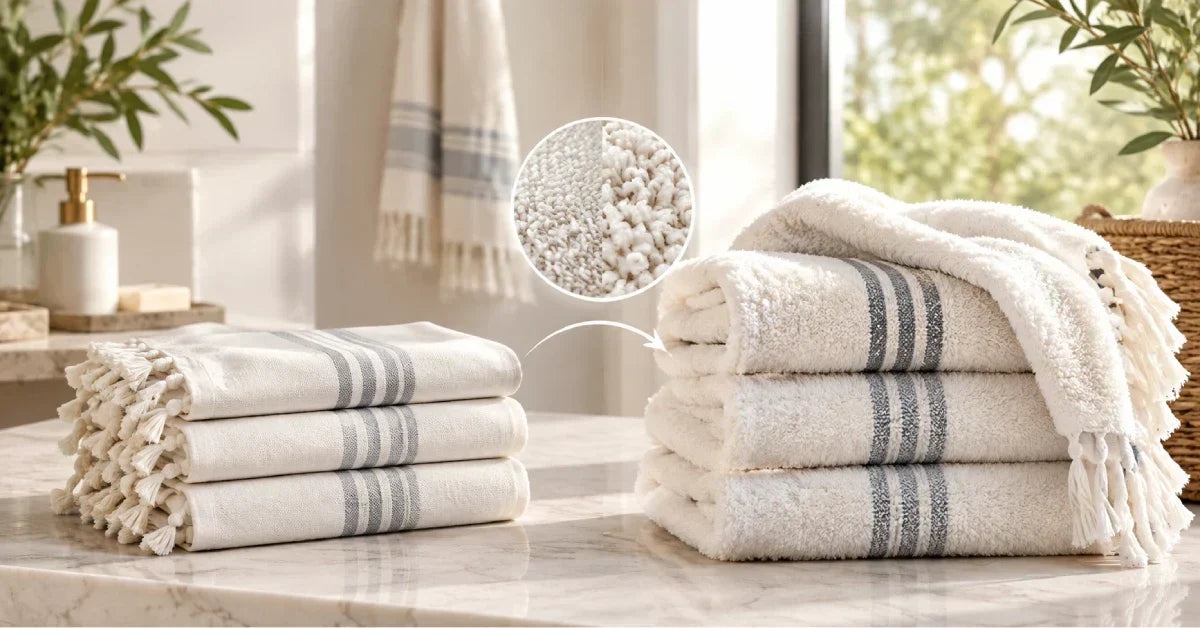
Most Turkish towels reach noticeable softness and strong absorbency after three to five total wash cycles, though the exact number depends on the weave. Flat woven peshtemal towels feel smooth within two to three washes, while thicker terry loop towels can take five to ten washes to fully open up.
| Towel Weave | Washes to Soften | Feel After Bloom | Best Suited For |
|---|---|---|---|
| Flat woven peshtemal | 2 to 3 washes | Light, smooth, quick drying | Travel, beach days, summer use |
| Waffle weave Turkish towel | 3 to 5 washes | Mid weight with texture | Everyday hand and face towels |
| Terry loop Turkish towel | 5 to 10 washes | Thick, plush, high absorbency | Daily bath and shower use |
Unlike conventional mass market towels, which peak in softness early and slowly degrade, well made Turkish towels keep improving with age instead of breaking down thanks to the resilience of long staple cotton [USDA].
Does Fabric Softener Ruin Turkish Towels?
Yes, commercial liquid fabric softener and dryer sheets reduce a Turkish towel's absorbency over time because they coat the cotton fibers in a thin hydrophobic film. That coating feels soft to the touch at first, but it blocks water absorption and eventually builds into a waxy layer that leaves the towel performing worse than it did straight out of the package.
Government guidance on fabric care notes that mineral and product residue left in fibers reduces the working lifespan of household linens and interferes with normal cleaning performance [EPA]. If your towels feel rough or slick rather than absorbent, sensitive skin can react to that residue too. Our guide to the best bath towels for sensitive skin covers fabric choices that limit irritation.
Vinegar or Fabric Softener: Which One Actually Works?
White vinegar outperforms fabric softener for towel care because it strips residue and lets the fibers open, while softener seals the fibers shut. The comparison below lays out why the two products behave so differently in the wash.
| Feature | Household White Vinegar | Commercial Fabric Softener |
|---|---|---|
| Mechanism | Strips detergent and mineral buildup plus leftover factory sizing | Coats fibers in a slick, silicone based film |
| Effect on absorbency | Restores and maintains absorbency | Sharply reduces water absorption |
| Long term effect | Keeps cotton open, clean, and blooming | Causes waxy buildup and permanent stiffness |
| Recognized use | Listed by the EPA as a common household cleaning chemical | Marketed for softness, not recommended for towels |
| Best used for | Periodic deep cleaning and the first few washes | Synthetic or poly blend fabrics, not natural cotton towels |
Does Vinegar Really Help New Towels Soften Faster?
Yes, about half a cup of distilled white vinegar added to the rinse cycle helps dissolve leftover sizing, detergent residue, and hard water mineral deposits during the first few washes. It works as a mild acid rinse rather than a coating agent, so it keeps the long staple fibers open instead of sealing them.
Hard water, meaning water with high concentrations of calcium and magnesium, is common across large parts of the United States and can leave abrasive mineral deposits on linens that make them feel rougher over time [EPA]. Vinegar helps counteract that mineral buildup, and household use of vinegar as a cleaning agent is acknowledged directly in EPA consumer guidance [EPA]. If odor rather than stiffness is the problem, our guide on removing stubborn mildew smell from towels walks through a deeper deodorizing routine.
Which Turkish Towel Type Softens Fastest, and Which Should You Buy?
Flat woven peshtemal towels soften the fastest, typically within two to three washes, because their thinner single layer weave has less yarn to relax. Choose a lighter peshtemal style if you want a towel that feels good almost immediately, or choose a heavier terry loop towel if you want maximum long term plushness and do not mind a longer break in period.
- Want a towel that softens fast with everyday use? Browse the full Turkish towels collection.
- Restocking your whole bathroom at once? A matched towel set blooms evenly since every piece goes through the same wash history.
- Recreating a spa routine at home? The spa and hamam accessories collection includes lighter weaves built for quick drying.
- Not sure where to start? The top sellers collection highlights the weaves most customers rebuy.
Weight also matters when comparing towels across brands. Our explainer on what GSM means in towels shows how gram weight relates to thickness, drying speed, and how long the bloom process takes.
How Should You Care for Turkish Towels for Years, Not Just the First Wash?
Keep Turkish towels soft for years by washing them regularly with a mild detergent, skipping fabric softener permanently, and drying on low heat, since high heat gradually breaks down natural cotton fibers. Rotate two or three towels so each one gets a full dry between uses, which also helps prevent musty odor and mildew buildup.
Manufacturers and importers are required to provide accurate care instructions on textile labels under federal rules, so the printed care label on your towel is a reliable starting point whenever it differs from general advice [FTC]. Country of origin and fiber content claims, including genuine Turkish cotton, are also protected under federal textile labeling law, which is part of why buying from a transparent retailer matters [FTC].
What Other Guides Will Help You Get the Most From Your Towels?
These related articles go deeper on specific care and buying questions raised in this guide:
- How to make towels soft again
- How to wash towels with vinegar and baking soda
- How to remove stubborn mildew smell from towels for good
- Turkish versus Egyptian cotton, fully compared
- The best bath towels for sensitive skin
- What GSM means in towels and why it matters
What Are the Sources for This Guide?
Every factual claim above is linked to one of the following primary sources at the point it is used. Full citations are listed again here for reference:
- U.S. Federal Trade Commission, Textile Fiber Products Identification Act (Textile Fiber Rule)
- U.S. Federal Trade Commission, Care Labeling of Textile Wearing Apparel and Certain Piece Goods
- U.S. Federal Trade Commission, Threading Your Way Through the Labeling Requirements Under the Textile and Wool Acts
- U.S. Department of Agriculture, Economic Research Service, Cotton Sector at a Glance
- U.S. Environmental Protection Agency, WaterSense, Water the Hard Facts, guide to selecting and maintaining a water softener
- U.S. Environmental Protection Agency, Safer Choice, Frequently Asked Questions
- U.S. Consumer Product Safety Commission, An Update on Formaldehyde, chemical finishes on consumer textiles
This guide is provided for general household care purposes and is not a substitute for the specific manufacturer care label on your towel.