Quick answer
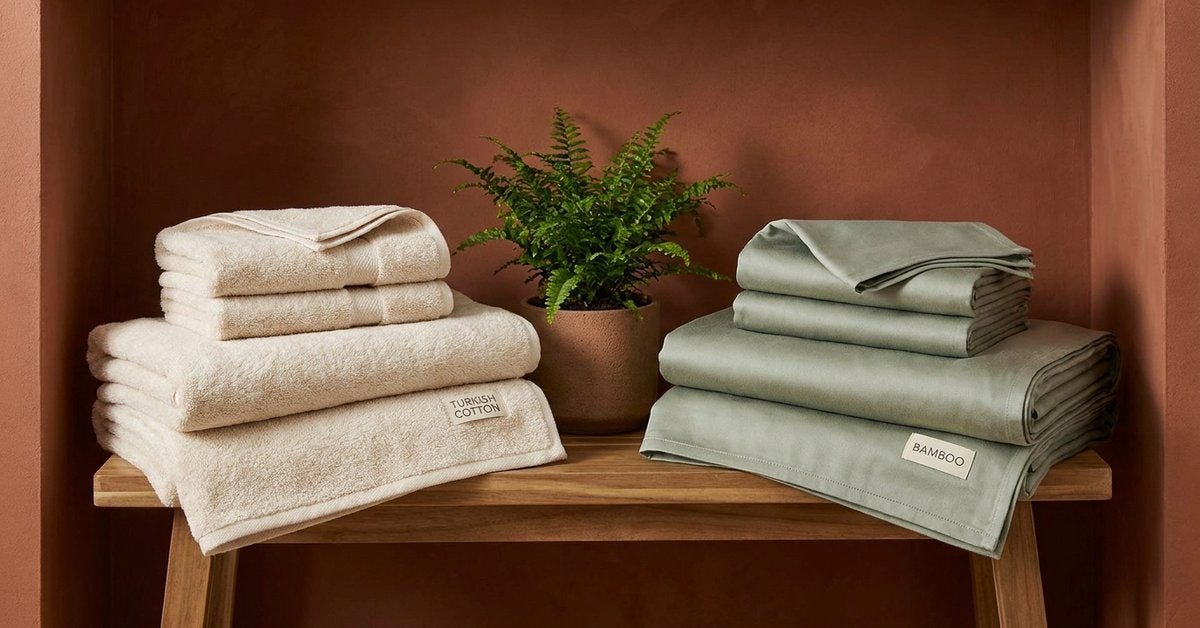
Turkish cotton towels last two to three times longer than bamboo viscose towels. A well cared for Turkish cotton towel typically survives 400 to 500 wash cycles, roughly 3 to 5 years of normal household use. A bamboo viscose towel usually breaks down after 150 to 200 wash cycles, or about 1 to 2 years. The reason is fiber chemistry: cotton gains strength when it gets wet, while bamboo viscose loses up to half of its strength the moment it absorbs water. Below you will find the lab reasoning, the labeling rules regulators enforce, the health considerations, a side by side comparison table, and a straightforward buying recommendation.
Which Towel Material Lasts Longer, Turkish Cotton or Bamboo?
Turkish cotton lasts longer, and the gap is large. Under standard residential washing and drying, a premium Turkish cotton towel endures 400 to 500 wash cycles, roughly 3 to 5 years, while a bamboo viscose towel typically shows thinning, frayed edges, and reduced strength after only 150 to 200 wash cycles, or about 1 to 2 years.
That difference is not marketing language. It reflects how each fiber behaves in water, how it tolerates heat and friction in a washing machine and dryer, and how it holds up against everyday bathroom humidity. The sections below explain each factor in plain terms, with figures you can check for yourself.
Why Does Turkish Cotton Outlast Bamboo Viscose?
Turkish cotton outlasts bamboo viscose because natural cotton fiber becomes stronger when wet, while bamboo viscose becomes weaker when wet. Long staple cotton grown in the Aegean region of Turkey increases its tensile strength by roughly 20 to 30 percent when saturated with water, whereas regenerated cellulose fibers such as bamboo viscose or bamboo rayon lose 30 to 50 percent of their structural strength as soon as they absorb moisture.
This single mechanical fact explains most of what follows. Every wash cycle soaks the towel, agitates it, spins it at high speed, and then tumbles it in a hot dryer. A fiber that weakens under those exact conditions is going to fail faster, no matter how soft it feels on day one.
How Do Fiber Structure and Wet Strength Actually Differ?
Cotton grown in the Aegean region of Turkey (Gossypium barbadense and premium Gossypium hirsutum cultivars) produces extra long staple fibers with a wet tenacity in the range of 3.5 to 4.0 grams per denier. Bamboo viscose, an extruded semisynthetic filament made by dissolving cellulose pulp, drops to roughly 1.0 to 1.5 grams per denier once wet, because the fiber wall swells and softens on contact with water.
Longer staples also create fewer exposed fiber ends when spun into yarn, which is the main reason Turkish cotton pills and sheds far less than bamboo over time. For a closer look at how staple length affects two premium cottons head to head, see this comparison of Turkish cotton against Egyptian cotton, which covers the same fiber science from a different angle.
How Do Turkish Cotton and Bamboo Towels Compare Side by Side?
The table below lines up the two materials across the metrics that matter most for everyday bathroom use: lifespan, strength, drying speed, and upkeep.
| Performance metric | Turkish long staple cotton | Bamboo viscose (rayon from bamboo) |
|---|---|---|
| Typical lifespan | 400 to 500 wash cycles (about 3 to 5 years) | 150 to 200 wash cycles (about 1 to 2 years) |
| Wet tensile strength | Increases by about 20 to 30 percent | Decreases by 30 to 50 percent |
| Indoor drying time | 2 to 4 hours | 6 to 10 hours |
| Moisture absorption | High, with balanced release | Extremely high, up to 3 times its weight |
| Pilling tendency | Very low | Moderate to severe |
| Snag and tear risk | Low, dense loop twist | High, delicate regenerated yarn |
| Mildew risk | Low, dries before spores establish | High, stays damp in typical bathrooms |
| Fiber production | Mechanical harvesting and ginning | Chemical dissolution using carbon disulfide and sodium hydroxide |
What Happens to Each Fabric During Machine Washing and Drying?
Turkish cotton tolerates standard American laundry settings, while bamboo viscose is damaged by them. Most homes in the United States wash on 105 to 120 degrees Fahrenheit and tumble dry on medium to high heat, and Turkish cotton handles that heat and friction with minimal fiber breakage, gradually softening over its first 15 washes as residual natural waxes rinse away.
Bamboo viscose filaments become brittle and snap under those same conditions, producing lint traps full of shed microfibers within roughly 6 months. The fabric care label exists precisely to prevent this kind of damage. Under the FTC Care Labeling Rule, every towel sold in the United States must carry a permanent label with washing, drying, and bleaching instructions, so checking that label before the first wash is the single easiest way to protect either fabric.
Why Does Turkish Cotton Perform Better in Humid Bathrooms?
Turkish cotton performs better in humid bathrooms because its looser, flatter yarn twist lets moisture wick outward and evaporate quickly, while bamboo viscose holds water inside dense, closely packed filaments. In room temperature tests at about 70 degrees Fahrenheit and 50 percent relative humidity, a 600 GSM Turkish cotton towel reaches 90 percent dry within 3 hours on a standard towel bar, while a 600 GSM bamboo viscose towel still retains more than 35 percent residual dampness at the 5 hour mark.
That gap matters because bathrooms are naturally humid rooms. The US Environmental Protection Agency recommends keeping indoor relative humidity below 60 percent and drying wet materials within 24 to 48 hours specifically because damp fabric left sitting for longer periods becomes a growth site for mold and mildew. A towel that stays wet for 6 hours or more, which is common for bamboo, gives mildew spores far more opportunity to take hold than a towel that dries in 3 hours.
What Problems Do Bamboo Towel Owners Commonly Report?
The most frequently reported bamboo towel problems are pulled loops and snags, a persistent damp odor, and stiffening or hem shrinkage after normal washing. Each one traces back to the same underlying weakness in wet, regenerated cellulose fiber.
- Snags and pulled loops: Bamboo filaments have a smooth, silky exterior with low natural crimp, so loops pull free easily when caught on a watch band, a fingernail, or a washing machine zipper, and a pulled loop cannot tighten itself back into place.
- Persistent damp odor: Because bamboo retains moisture for extended periods, mold species such as Aspergillus and Cladosporium can multiply inside the damp core. Manufacturers often advertise natural antimicrobial properties, but that trait belongs to raw bamboo grass and is chemically removed during the viscose manufacturing process. See this guide on removing stubborn mildew smell from towels for good if the odor has already set in.
- Stiffening and hem shrinkage: Standard US dryer settings above 110 degrees Fahrenheit shrink bamboo hems unevenly and stiffen the loops, creating a distorted, board like edge that will not soften back up with normal washing.
How Should You Wash and Care for Each Towel Type?
Turkish cotton tolerates warm to hot water and medium heat drying, while bamboo viscose needs cold water and low heat or line drying to survive. Proper care extends a Turkish cotton towel well beyond 5 years, while bamboo needs a gentle, low heat routine simply to reach the 2 year mark.
Turkish cotton washing protocol
- Water temperature: warm at about 105 degrees Fahrenheit for colors, and occasionally hot at 140 degrees Fahrenheit for whites.
- Detergent: a mild liquid detergent without optical brighteners. Avoid silicone based fabric softeners, which coat the loops and can cut absorbency by up to 30 percent.
- Drying: medium heat. Turkish cotton fluffs naturally as it tumbles.
Bamboo viscose washing protocol
- Water temperature: cold or lukewarm only, no higher than about 85 to 90 degrees Fahrenheit, since hot water breaks down the regenerated cellulose bonds.
- Agitation: a gentle or delicates cycle, kept away from denim, canvas, or anything with exposed hardware.
- Drying: low heat or line dry only.
If either towel has already gone stiff, scratchy, or dull, these two guides walk through the fix step by step: how to make towels soft again and washing towels with vinegar and baking soda, a natural, softener free method that also helps strip built up detergent residue.
Are Bamboo Towels Labeled Accurately by Retailers?
Often, no. Under the Textile Fiber Products Identification Act, a textile can only be called bamboo if it is made directly from raw bamboo fiber, and fabric created by dissolving bamboo cellulose in chemicals must legally be labeled as rayon or viscose made from bamboo, not as bamboo itself.
The Federal Trade Commission has pursued repeated enforcement actions against major US retailers over this exact issue. In 2022 the agency used its penalty offense authority to bring record civil penalties against Kohls and Walmart, ordering payments of 2.5 million dollars and 3 million dollars respectively for marketing rayon textiles as bamboo and for falsely claiming the products were produced through an environmentally friendly process. Earlier actions in 2010 and 2013 covered dozens of additional retailers, including Amazon, Target, Sears, and Bed Bath and Beyond, for the same type of mislabeling. Industry estimates suggest that more than 90 percent of retail bamboo towels sold in the United States are standard chemically processed viscose rather than a true bamboo fabric.
Is Bamboo Fabric Actually Environmentally Friendly?
Only partly. Raw bamboo itself is a fast growing, pesticide free grass, but converting that grass into soft viscose yarn requires an intensive chemical process that is not environmentally gentle at all.
The standard viscose process runs roughly as follows: raw bamboo stalks are mechanically chipped into pulp, the pulp is dissolved using carbon disulfide and sodium hydroxide, the resulting viscous solution is extruded through an acid spinneret, and the output is regenerated cellulose yarn, commonly sold as viscose or rayon.
Carbon disulfide is the chemical of greatest concern in that process. According to the CDC's National Institute for Occupational Safety and Health, exposure to carbon disulfide can cause dizziness, headache, vision changes, and harm to the eyes, kidneys, blood, heart, liver, nerves, and skin, and it is a recognized occupational hazard among workers at fiber processing plants. Only fabric certified as bamboo lyocell, produced through a closed loop solvent method that recovers about 99.5 percent of the processing chemicals, avoids this pollution. As noted above, that certified process accounts for a small minority of what is actually sold as bamboo towels.
Turkish cotton, by comparison, relies on agricultural water use but requires no industrial solvent dissolution, produces no synthetic offgassing, and biodegrades naturally at the end of its useful life.
Is Bamboo or Turkish Cotton Better for Sensitive Skin?
For most people with sensitive or eczema prone skin, Turkish cotton is the more reliable choice, mainly because it dries faster and does not sit damp against the skin. Bamboo viscose feels smooth right out of the package, but the fabric finish and how quickly it dries matter more for skin health than the raw fiber source.
According to the National Institutes of Health, keeping skin dry and avoiding prolonged contact with damp or rough materials is a core part of managing atopic dermatitis and other eczema type conditions. A towel that remains damp for 6 to 10 hours creates exactly the kind of environment that can aggravate irritated skin. Turkish cotton certified under recognized textile safety standards avoids harsh processing residues while drying quickly enough to limit that risk. For a deeper look at fabric options for reactive skin, see the best bath towels for sensitive skin.
How Does GSM Affect Towel Quality and Lifespan?
GSM, short for grams per square meter, measures how densely a towel is woven, and it directly affects both absorbency and how long a towel lasts. Most of the figures in this guide, including the 600 GSM humidity tests, refer to a mid to heavy weight towel, which is the range most home bathrooms use for the best balance of absorbency and drying speed.
If you are comparing weights while shopping, this explainer on what GSM means in towels breaks down which range suits bath towels, hand towels, and washcloths. You can browse woven, long staple options directly in the Turkish towels collection.
Which Towel Should You Actually Buy?
For most households, buy Turkish cotton. It lasts 2 to 3 times longer, dries in a third of the time, tolerates normal US washing machine and dryer settings, and carries a lower risk of mildew and skin irritation in a typical humid bathroom.
Bamboo viscose still has a place for buyers who want an initial silky texture and are willing to hand wash or use a delicates cycle, line dry every time, and replace the towel within 1 to 2 years. For everyone else, especially households with kids, shared bathrooms, or limited laundry time, the practical, lower maintenance choice is Turkish cotton.
| Buyer profile | Recommended towel |
|---|---|
| Busy household, shared bathroom, wants low maintenance | Turkish cotton |
| Humid climate or limited bathroom ventilation | Turkish cotton |
| Sensitive or eczema prone skin | Turkish cotton |
| Wants a silky first touch and will hand wash gently | Bamboo viscose (bamboo lyocell if available) |
| Shopping by weight and durability | 600 GSM or higher Turkish cotton |
Ready to shop? Start with the Turkish towels collection for individual pieces, browse Turkish cotton towel sets for a full bathroom refresh, check the top selling towels for the most reordered styles, or add a few spa and hamam accessories if you are building out a full at home spa routine.
Sources
- US Federal Trade Commission, Bamboo Textiles enforcement summary
- US Federal Trade Commission, FTC Uses Penalty Offense Authority to Seek Largest Ever Civil Penalty for Bogus Bamboo Marketing from Kohls and Walmart, 2022
- US Federal Trade Commission, Clothes Captioning, Complying with the Care Labeling Rule
- US Environmental Protection Agency, A Brief Guide to Mold, Moisture, and Your Home
- National Institutes of Health, NIAMS, Atopic Dermatitis: Diagnosis, Treatment, and Steps to Take
For most households, Turkish cotton certified under recognized textile safety standards remains the longer lasting, lower maintenance, faster drying investment. Bamboo viscose still suits buyers who prioritize an initial silky feel and are willing to hand wash and replace the towel within 1 to 2 years.