Last updated September 2026. Reviewed against U.S. federal guidance on textile care, home moisture control, and laundry energy use.
Quick Answer
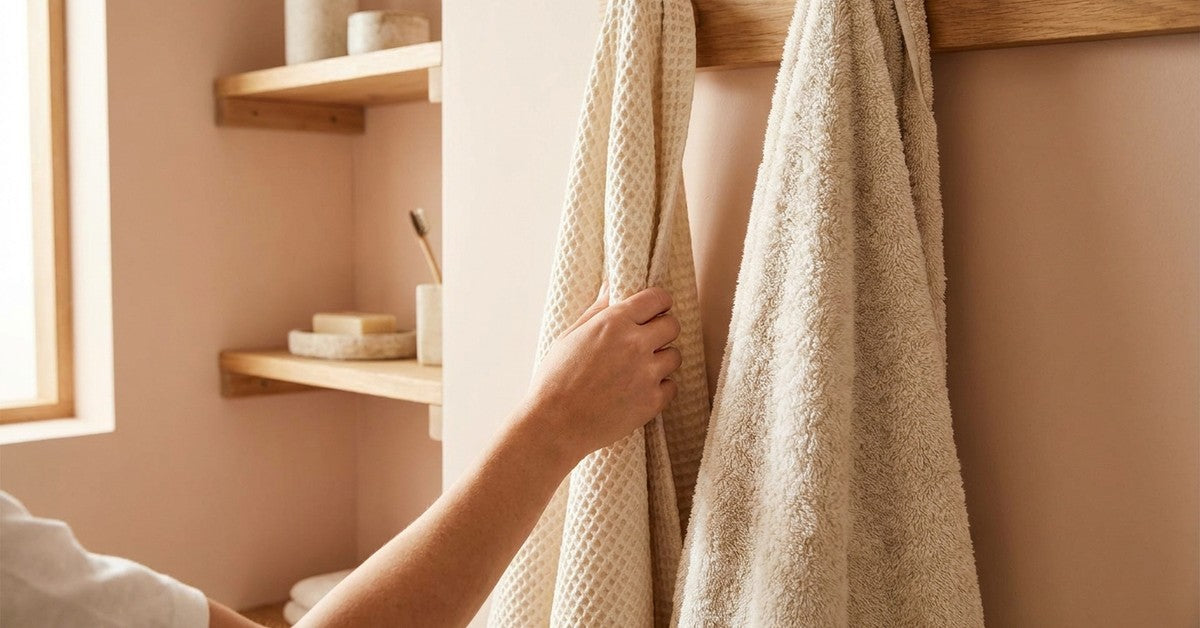
Waffle weave (also called honeycomb weave) is a cotton, linen, or bamboo fabric woven with a raised 3D grid that lifts the material off the skin and boosts airflow. Because of that structure, a typical 350 gram per square meter (GSM) waffle towel line dries in about 2 to 3 hours, while a comparable 600 GSM terry towel takes 5 to 7 hours under the same room conditions, roughly 50 to 60 percent longer.
- Structure: a dobby loom weaves raised ridges and recessed pockets instead of looped pile, giving about 20 to 30 percent more exposed surface area than a flat weave of the same size.
- Weight range: mills typically produce waffle fabric between 200 and 500 GSM, compared with 500 to 800 GSM for terry cloth, according to industry weaving standards.
- Drying: waffle towels hold roughly 3 to 4 times their dry weight in water, versus 5 to 7 times for terry cloth, so there is simply less liquid mass to evaporate.
- Mold prevention: the U.S. Environmental Protection Agency advises drying wet textiles within 24 to 48 hours to stop mold growth, a window waffle weave clears far more easily than dense terry pile.
- Best use: pick waffle weave for fast drying towels, robes, and travel linens; pick terry cloth or a terry lined waffle robe when plush warmth matters more than dry time.
What Is Waffle Weave Fabric?
Waffle weave, also known as honeycomb weave, is a woven textile with a three dimensional grid of raised ridges and recessed square or diamond pockets that lift the fabric off the skin. It is produced on a dobby loom using alternating warp and weft floats, which sets it apart from flat weaves such as percale or poplin and from looped pile fabrics such as terry cloth.
The loom sequences warp threads across multiple weft passes to build a textured surface that looks almost identical to a kitchen waffle. Mills generally produce waffle fabric between 200 and 500 grams per square meter (GSM). A lighter 200 to 300 GSM weave suits tissue weight towels and summer garments, while a heavier 400 to 500 GSM weave produces structural bath sheets, spa robes, and thermal throws. The design has been used for centuries in France and around the Mediterranean as a durable, breathable household textile, and long staple cotton remains the most common fiber, though Turkish and Egyptian cotton differ in staple length and hand feel in ways worth understanding before you buy.
Cotton used in premium waffle textiles is typically graded against national fiber quality benchmarks; the USDA Agricultural Marketing Service maintains the physical cotton standards mills use to test strength, fineness, and length before the fiber ever reaches a loom.
Why Does Waffle Weave Dry Twice as Fast as Terry Cloth?
Waffle weave dries about 50 to 60 percent faster than looped terry cloth because its raised grid increases exposed surface area and lets air move straight through the fabric instead of pooling inside dense loops. In normal indoor conditions, around 70°F and 40 to 50 percent relative humidity, a 350 GSM cotton waffle towel line dries in 2 to 3 hours, while a 600 GSM terry towel needs 5 to 7 hours.
Three physical factors drive the difference:
- Increased evaporative surface area: the recessed squares and raised ridges add roughly 20 to 30 percent more exposed surface area per square inch than a flat woven sheet of the same size, which speeds the change from liquid to vapor.
- Low airflow resistance: terry cloth holds water in thousands of tightly packed yarn loops, while waffle weave has no pile, so air circulates freely through the open cellular grid and continuously pulls moisture out of the fibers.
- Lower water mass: because waffle towels weigh roughly 30 to 40 percent less per square foot than thick terry towels, they hold less total water when wrung out, which shortens evaporation time even further.
The U.S. Department of Energy notes that dryers work by moving heated air through wet fabric to evaporate and vent moisture, so fabric that lets air pass through easily, like waffle weave, reaches dryness with less heat and less energy than dense pile fabric.
What Is the Difference Between Waffle and Terry Weave?
The main difference is structural: waffle fabric channels air and moisture through a raised 3D grid, while terry cloth uses thousands of upright yarn loops to physically trap liquid. That single design choice explains nearly every other difference in the table below.
| Feature | Waffle weave (honeycomb) | Terry cloth (looped pile) |
|---|---|---|
| Fabric structure | 3D recessed grid on a dobby loom | Upright surface yarn loops (pile) |
| Typical weight | 250 to 450 GSM | 500 to 800 GSM |
| Total water retention | Low to moderate, about 3 to 4 times dry weight | Very high, about 5 to 7 times dry weight |
| Indoor line dry time at 70°F | 2 to 3 hours | 5 to 7 hours |
| Dryer cycle energy use | About 30 to 40 percent shorter cycle | Full cycle; heavy pile retains steam |
| Storage bulk | Folds to roughly half the volume of terry | Bulky; fills linen closets quickly |
| Texture | Light mechanical texture, invigorating | Cushioned, plush hand feel |
| Mildew and odor resistance | High; dries before bacteria proliferate | Moderate to low; prone to musty odor |
Terry cloth wins on immediate, plush water capture right out of the shower. But holding a large volume of moisture in a dark, humid bathroom is also exactly the condition the EPA flags as ideal for mold growth. Waffle weave trades some of that dense pile for faster drying, lower storage bulk, and crisper breathability.
Why Do Luxury Hotels and Spas Choose Waffle Robes?
Spas and resorts choose waffle robes because they cut commercial laundry drying time, reduce linen cart storage by about half compared with heavy terry, and fit a wide range of body types without clinging when damp. That combination lowers both utility costs and back of house labor for properties handling hundreds of robe changes a day.
The ENERGY STAR clothes dryer guidance notes that dryers with moisture sensors shut off automatically once a load is dry, which prevents over drying and wasted cycles; lighter, faster drying waffle robes reach that shutoff point sooner than saturated terry robes, saving both time and electricity across large scale laundry operations.
Beyond the utility bill, a waffle kimono or shawl collar robe holds a crisp, structured drape that resists clinging to damp skin, and the recessed pockets promote passive air circulation in sauna, steam, and hydrotherapy zones so guests do not overheat. Browse the full range of spa and hamam accessories or shop bathrobes directly to compare weights and weaves. If you want general styling guidance first, this guide to types of robes and this breakdown of the best robe for a hot tub in winter both cover how weave and weight change warmth.
How Does Honeycomb Weave Fabric Regulate Body Temperature?
Honeycomb weave regulates temperature by trapping a thin layer of still, circulating air inside its recessed pockets, which acts as a light thermal barrier when layered under a blanket or outer shell. In warm weather worn alone, the opposite effect takes over: only the raised ridges touch the skin, so sweat vapor escapes through the open recessed sections instead of forming a damp seal.
That two way behavior is what makes waffle weave useful across seasons, from an insulating layer under winter bedding to an evaporative cooling layer on a humid morning. For heavier weight seasonal use, compare styles in the throws and blankets collection.
How Should You Wash and Care for Waffle Weave Linens?
Wash waffle weave in cold or warm water under 104°F (40°C) on a gentle cycle, then either line dry or tumble dry on low heat. Skipping fabric softener and bleach, and drying promptly, preserves both the raised grid structure and the fabric's absorbency over time.
- Avoid fabric softener: silicone based softeners coat cotton fibers in a water repellent layer that clogs the cellular pores of the weave and reduces absorbency over repeated washes.
- Skip bleach: chlorine breaks down cellulose fibers over time, which frays the raised ridge walls of the honeycomb structure and reduces its elasticity.
- Expect the pucker: freshly washed waffle fabric tightens into a pronounced 3D texture as the grid pockets contract. That is a normal structural feature, not shrinkage damage, and it relaxes slightly with everyday use.
- Prevent snagging: store waffle textiles away from open zippers, metal snaps, and hook and loop fasteners, which can catch the long float yarns of the dobby weave.
Two federal rules apply directly here. The FTC Care Labeling Rule requires manufacturers and importers of textile wearing apparel to attach accurate washing and drying instructions, so a waffle robe's care label is a legal requirement, not just a suggestion. Robes and other wearing apparel also fall under the CPSC Flammable Fabrics Act standard, codified at 16 CFR part 1610, which sets flammability testing classes for clothing textiles sold in the United States.
For deeper cleaning, this guide to washing towels with vinegar and baking soda covers a gentler alternative to commercial softener, and if odor has already set in, see how to remove stubborn mildew smell from towels for good. Both pair well with the EPA guidance to dry wet textiles within 24 to 48 hours and the Department of Energy laundry tips on using a moisture sensor cycle to avoid over drying.
What GSM Should You Choose for Waffle Towels and Robes?
Choose 250 to 300 GSM waffle fabric for fast drying travel and gym towels, 350 to 400 GSM for everyday bath towels and lightweight robes, and 450 GSM or heavier for plush spa robes and winter throws. Matching GSM to the way you actually use the item balances dry time against warmth and hand feel far better than picking the heaviest option by default.
| Use case | Recommended GSM | Best fit |
|---|---|---|
| Travel or gym towel | 200 to 300 GSM | Packs small, dries within a few hours between uses |
| Everyday bath towel | 300 to 400 GSM | Balances absorbency with a same day dry cycle |
| Spa or hotel style robe | 350 to 450 GSM | Structured drape, faster commercial laundry turnaround |
| Kids robe | 250 to 350 GSM | Lighter weight is easier for small arms and dries fast after bath time |
| Winter throw or blanket layer | 450 GSM and up | Heavier grid traps more warm air for insulation |
For a full breakdown of how weight is measured, see this explainer on what GSM means in towels. If you are shopping by category, compare options in Turkish towels, terry cotton bathrobes, or the dedicated kids bathrobe collection for smaller sizing.
Sources
- U.S. Environmental Protection Agency, "A Brief Guide to Mold, Moisture and Your Home"
- U.S. Environmental Protection Agency, "What Are the Main Ways to Control Moisture in Your Home"
- Federal Trade Commission, "Clothes Captioning: Complying with the Care Labeling Rule"
- ENERGY STAR, "Clothes Dryers"
- USDA Agricultural Marketing Service, "Cotton Fiber Testing and Standardization"
- U.S. Consumer Product Safety Commission, "Flammable Fabrics Act" business guidance (16 CFR part 1610)
"
"