Updated September 2026 · Reviewed for accuracy against primary regulatory and certifier sources
Quick Summary
OEKO-TEX Standard 100 is a private laboratory certification, not a government law. It checks a finished textile for more than 1,000 regulated and non regulated substances, including banned dyes, heavy metals, and PFAS, and it does not verify organic farming, factory emissions, or fair labor. Certificates last 12 months, are graded into four product classes, and can be checked for free on the official OEKO-TEX Label Check tool. This guide explains what the label proves, what it leaves out, how it compares with GOTS, and which government agencies regulate the gaps it does not cover.
What Is OEKO-TEX Standard 100, In Plain Terms?
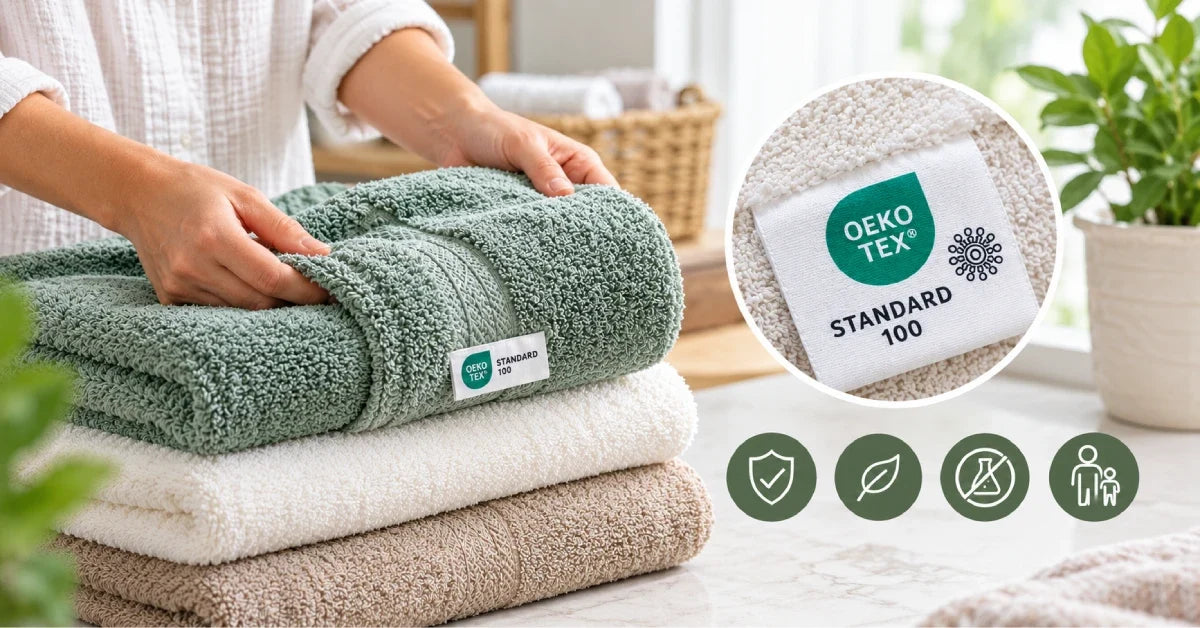
OEKO-TEX Standard 100 is an independent chemical safety certification for finished textiles, awarded after a product passes laboratory screening for more than 1,000 substances. It was founded in 1992 by the International Association for Research and Testing in the Field of Textile and Leather Ecology, a network of accredited institutes such as Hohenstein and Testex.
Rather than checking how a crop was grown, the test looks only at the finished item, including sewing thread, buttons, zippers, linings, and coatings. According to OEKO-TEX's own program page, the association awarded more than 43,000 certificates and labels in a single recent fiscal year to roughly 21,000 manufacturers, brands, and trading companies across over 100 countries, which makes it the most widely used textile chemical safety label in the world.
Testing criteria are reviewed at least once a year so the limit values keep pace with new science and new bans. That review cadence is one reason a certificate is only valid for 12 months before a brand must retest.
What Chemicals Does OEKO-TEX Standard 100 Actually Test For?
OEKO-TEX Standard 100 screens for banned azo dyes, formaldehyde, nickel, cadmium, pesticide residues, phthalates, chlorophenols, and PFAS, among other substance groups. Every limit is expressed as a concrete number rather than a vague pass or fail rating, which is what makes the test verifiable in a lab.
| Substance Category | Concrete Limit Or Rule | Why It Matters |
|---|---|---|
| PFAS (forever chemicals) | Total organic fluorine capped at 100 mg/kg since 2023 | Prevents standard fluorinated water repellent finishes from passing |
| Skin pH | Must fall between 4.0 and 7.5 | Matches the natural acid mantle of human skin |
| Formaldehyde | Strictest limit in Product Class I (baby items) | Reduces risk of irritation from wrinkle resistant finishing resins |
| Heavy metals | Nickel and cadmium capped per product class | Limits allergic reaction and long term metal exposure |
| Phthalates and plasticizers | Regulated in prints and coatings | Common in synthetic prints and waterproof layers |
| Pesticide residues | Extracted and measured from raw plant fibers | Confirms residues wash out below lab detection limits |
For a closer look at how fabric weight and fiber choice affect comfort alongside chemical safety, see this explainer on what GSM means in towels, which covers how density and fiber type change how a textile feels and performs.
What Does OEKO-TEX Standard 100 Not Certify?
OEKO-TEX Standard 100 does not certify that a fabric is organic, biodegradable, low carbon, or made under fair labor conditions. It is strictly a finished product chemical screen, not a farm to factory lifecycle audit.
- Not organic: synthetic pesticides, petroleum fertilizers, and GMO seeds are allowed if residues test below detection limits.
- Not a factory emissions check: wastewater, air emissions, and carbon footprint are outside its scope.
- Not a labor audit: wages and working conditions are covered by a separate OEKO-TEX program called STeP, not Standard 100.
- Not a microplastic guarantee: certified synthetic fleece and polyester can still shed microfibers in the wash.
How Do The Four OEKO-TEX Product Classes Work?
OEKO-TEX Standard 100 sorts textiles into four product classes based on how closely and how often the fabric touches skin. Product Class I, covering babies and toddlers, enforces limits that can run up to ten times stricter than Classes II through IV.
| Class | Contact Profile | Example Products |
|---|---|---|
| Class I | Babies and toddlers, ages 0 to 36 months | Clothing, crib sheets, cloth diapers, soft toys |
| Class II | Direct, extended skin contact | Underwear, bed linens, towels, base layers |
| Class III | No direct skin contact | Jackets, coats, linings, structural padding |
| Class IV | Furnishing and décor materials | Curtains, upholstery, table linens, mattress ticking |
Class I items also undergo mandatory saliva and perspiration resistance testing, since infants chew and drool on fabric. If you are choosing a robe for a young child, this guide to picking the best fabric for a toddler bathrobe and this toddler robe size chart both explain how to match fit and fiber to a child's sensitive skin, and Thirsty Towels' kids bathrobe collection is built around soft, breathable fibers for that same age group.
For adults, next to skin categories like towels and underwear fall under Class II. This roundup of bath towels for sensitive skin walks through fiber and finishing choices that reduce irritation risk in that same contact category.
How Is OEKO-TEX Different From GOTS?
OEKO-TEX Standard 100 certifies only the chemical safety of a finished item, while GOTS, the Global Organic Textile Standard, certifies the entire organic farming and processing chain plus labor conditions. In short, GOTS tracks a product from the cotton seed to the final stitch, while OEKO-TEX tests the final material in a lab.
| Factor | OEKO-TEX Standard 100 | GOTS |
|---|---|---|
| Primary scope | Chemical toxicity of the finished good | Organic status and social ethics across the supply chain |
| Fiber rules | Any fiber allowed, including polyester and nylon | 70 to 95 percent certified organic natural fiber required |
| Farming practices | Not reviewed; synthetic sprays permitted | Non GMO; no synthetic pesticides or fertilizers |
| Labor audits | Not included (covered by the separate STeP program) | Mandatory ILO labor standards across the supply chain |
| Best suited for | Performance fabrics, synthetics, budget cotton | Pure organic bedding, organic cotton basics |
According to the official GOTS site, the standard was developed jointly by the Organic Trade Association, IVN, the Soil Association, and the Japan Organic Cotton Association, and today certifies operations across the full manufacturing chain, not just the finished garment.
Shoppers who want organic fiber content specifically can start with Thirsty Towels' organic cotton bathrobes collection, and the difference between fiber origins is explained further in Turkish cotton versus Egyptian cotton.
What Other OEKO-TEX Labels Exist Beyond Standard 100?
OEKO-TEX issues six certifications beyond Standard 100, ranging from factory audits to chemical manufacturer approval. The most complete of these is MADE IN GREEN, which combines Standard 100 chemical testing with STeP facility standards and adds a scannable product ID.
- MADE IN GREEN by OEKO-TEX: combines Standard 100 chemical safety with STeP responsible manufacturing and a traceable QR code.
- OEKO-TEX ORGANIC COTTON: verifies non GMO status and pesticide free farming through DNA screening.
- OEKO-TEX STeP: a factory level audit of working conditions, wastewater handling, and chemical storage.
- OEKO-TEX ECO PASSPORT: certifies dyes and finishing chemicals before mills use them.
- OEKO-TEX LEATHER STANDARD: targets chromium VI and other leather specific tanning risks.
How Do You Verify An OEKO-TEX Certificate Number?
You verify a certificate by entering the exact alphanumeric number printed on the product tag into the official OEKO-TEX Label Check tool. If a brand claims OEKO-TEX certification without printing a certificate number and testing institute, that claim cannot be independently confirmed.
Step 1: Find The Label
Look for the rectangular OEKO-TEX logo with a testing institute name (for example Hohenstein or Testex) and a certificate number formatted like 12.HCN.12345 or a plain eight digit number.
Step 2: Open The Label Check Tool
Go to the official verification page at oeko-tex.com/en/label-check and enter the number exactly as printed, including dots.
Step 3: Read The Status
A valid result lists the certified product group and product class. A suspended or expired result means the manufacturer failed to renew or failed an annual audit. A not found result means the number is fabricated or mistyped.
Step 4: Match The Scope
Confirm the certificate description matches the exact finished garment and color you are holding, since some sellers apply a certified yarn's number to an uncertified finished print.
Which Textiles Are Actually Worth Paying Extra For OEKO-TEX?
OEKO-TEX Standard 100 is worth the modest price premium on items with long, direct skin contact, and worth less on loose outer layers. Bedding, base layers, and baby items sit against skin for hours at a time, which raises the value of a verified chemical safety screen.
| Category | Recommendation | Reasoning |
|---|---|---|
| Baby and toddler items | Prioritize Class I certified | Thinner skin and immature detoxification pathways raise risk |
| Bedding and towels | Prioritize certified | Extended direct contact and inhalation of any residues during use |
| Base layers and underwear | Prioritize certified | Heat and sweat increase dermal absorption of dyes and finishes |
| Winter coats and outerwear | Certification optional | Rarely touches bare skin for meaningful duration |
| Drapery and rugs | Certification optional | Minimal to no direct skin contact |
Two related reads worth pairing with this decision: the best towels for drying the body and how to make towels soft again, which explains how finishing chemicals and washing routines affect hand feel over time.
Does Any Government Agency Regulate What OEKO-TEX Does Not Cover?
Yes. OEKO-TEX Standard 100 is a private certification with no legal force, but several government agencies enforce mandatory rules that fill in adjacent gaps such as flammability, labeling accuracy, and specific banned chemicals. These government rules apply to every textile sold in their jurisdiction, certified or not.
- The U.S. Consumer Product Safety Commission's Flammable Fabrics Act sets mandatory flammability classes for clothing textiles, an area OEKO-TEX Standard 100 does not test at all.
- The CPSC's 2018 phthalate rule bans eight specific phthalates above 0.1 percent in children's toys and child care articles sold in the United States, a legal floor that sits alongside OEKO-TEX's private limits.
- The EPA's PFAS overview explains federal research and regulatory action on forever chemicals, the same substance family OEKO-TEX capped at 100 mg/kg starting in 2023.
- The FTC's Textile and Wool Acts labeling guide requires accurate fiber content, country of origin, and manufacturer identity on labels, which is separate from and unrelated to any chemical safety claim.
- CDC and NIOSH's formaldehyde reference documents occupational exposure limits for formaldehyde, the same wrinkle resistant finishing chemical that OEKO-TEX restricts most tightly in Class I baby items.
- The USDA's organic certification program governs when a textile can legally carry the USDA organic seal, which is a separate legal claim from both OEKO-TEX and GOTS.
Recommendation: How To Shop With Confidence
Treat OEKO-TEX Standard 100 as a chemical safety floor, then layer on fiber and care choices that match your actual use case. For next to skin categories like towels, robes, and baby items, look for a printed certificate number you can check on Label Check; for outerwear and décor, the certification matters far less.
- Start with fiber quality. Browse Turkish towels for absorbent, naturally soft cotton that pairs well with a Class II style certification.
- Match robe weight to season and skin sensitivity using Thirsty Towels' bathrobe collection, and read how to make towels soft again if softness fades over time.
- Keep certified textiles free of residue buildup with routine, gentle washing rather than harsh additives; this guide on washing towels with vinegar and baking soda and this one on removing stubborn mildew smell from towels both cover safe, non abrasive methods.
- For children, pair a Class I certified robe from the kids bathrobe collection with the sizing guidance in the toddler robe size chart guide so fit and fabric are both right.
- If organic fiber sourcing matters more than synthetic performance, compare the organic cotton bathrobes collection against a standard terry option before buying.
Sources
Government and regulatory sources
- U.S. CPSC — Flammable Fabrics Act
- U.S. CPSC — Phthalate ban in children's toys and child care articles (2018)
- U.S. EPA — PFAS Explained
- U.S. FTC — Textile and Wool Acts labeling requirements
- CDC / NIOSH — Formaldehyde Pocket Guide to Chemical Hazards
- USDA AMS — Organic Certification and Accreditation
Certification body sources