Updated for accuracy • Reviewed against manufacturer, fiber science, and U.S. federal safety sources
Quick Summary
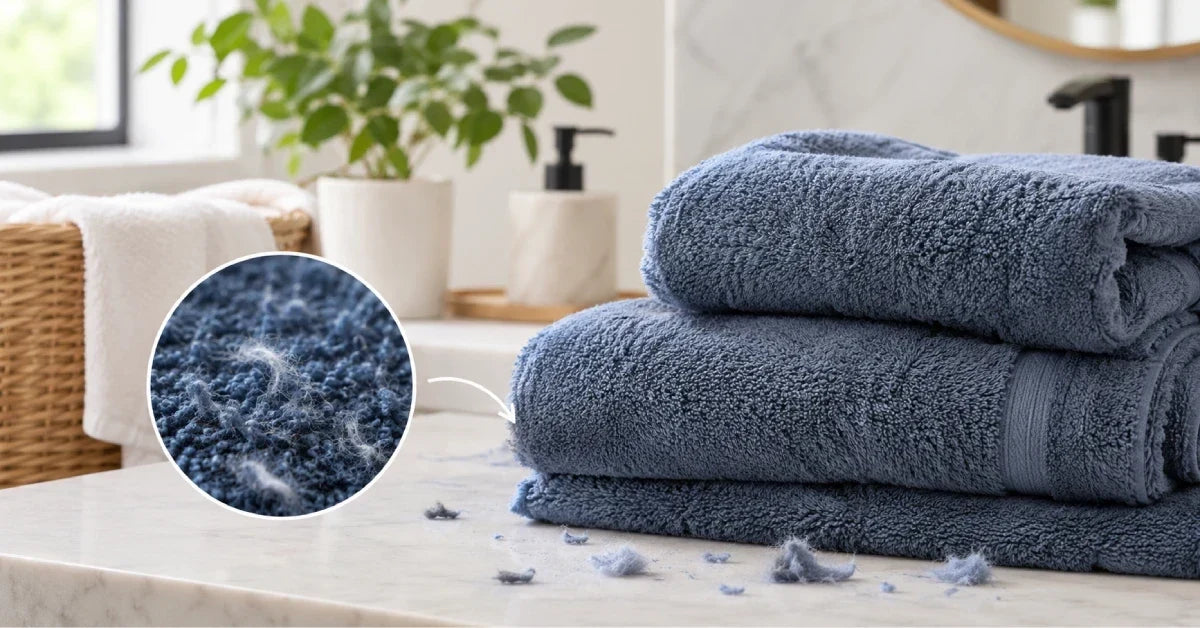
New towels shed lint because short, loose cotton fibers left over from manufacturing are trapped inside the terry loops, and factory finishing chemicals hold that fuzz in place until it is washed out. Here is the short version before the full breakdown:
- Shedding is normal and temporary, not a defect. It happens because of loose staple fibers and a factory finishing coating.
- Wash new towels alone in warm water with 1 cup of white vinegar, then a second wash with ½ cup of baking soda, before using them.
- Skip liquid fabric softener. It coats fibers in wax, trapping lint and cutting absorbency.
- Flat weave Turkish towels usually stop shedding in 1 to 2 washes; standard terry cloth takes 3 to 5; heavy plush towels can take 6 to 10 or more.
- Uncleaned lint is not only cosmetic. The U.S. Fire Administration reports that failure to clean was the leading factor in 31 percent of home clothes dryer fires from 2018 to 2020.
Bringing home a set of plush, vibrant new bath towels should feel like a small luxury. Yet the first post shower wipe can leave your skin covered in tiny fuzz balls, or your dryer trap looking like it exploded. This guide explains exactly why that happens, how long it lasts by towel type, and the fastest, safest way to stop it, backed by fiber science, federal labeling rules, and fire safety data.
Why Do New Towels Shed Lint?
New towels shed lint because short, unattached cotton fibers, called staple fibers, break loose during spinning, cutting, and stitching, then stay trapped inside the towel's terry loops until friction and water shake them free. Every cotton towel is woven from thousands of individual strands, and a percentage of those strands are always shorter than the main yarn.
During manufacturing, these fragments do not fall away on the factory floor. Instead, they nest deep inside the dense pile until your first wash or first use dislodges them all at once, which is why the shedding feels sudden and heavy rather than gradual.
What Causes New Towels to Shed More Than Older Ones?
New towels shed more than older ones mainly because of a chemical finishing coating applied at the factory, on top of the loose staple fibers already trapped in the weave. Manufacturers apply silicone based softening agents so towels feel plush on the store shelf, and that coating acts like a temporary glue holding loose fuzz in place.
Under the Federal Trade Commission's Textile Fiber Products Identification Act rules, manufacturers must disclose the fiber content and percentage by weight on the label, but they are not required to disclose finishing chemicals, which is why two towels labeled 100 percent cotton can shed very differently depending on how they were finished. Until that coating breaks down in the wash, trapped lint cannot release cleanly, so it works its way out gradually onto your skin and clothing instead.
If your towels also feel stiff while they finish shedding, see how to make towels soft again for a full softening routine that will not interfere with the lint removal steps below.
How Do You Stop New Towels From Shedding Lint?
You stop new towels from shedding lint fastest by washing them alone in warm water with white vinegar, followed by a second wash with baking soda, then tumble drying with wool dryer balls. This four step sequence strips the factory coating and physically shakes loose fibers into the lint trap instead of onto your skin. For the exact ratios and a version you can reuse for regular maintenance washes, see our full guide to washing towels with vinegar and baking soda.
| Step | Method | Exact Amount | Purpose |
|---|---|---|---|
| 1 | Isolate the load | Towels only, no clothing or linens | Stops lint transferring to other fabrics |
| 2 | White vinegar wash | 1 cup distilled white vinegar, warm water, no detergent | Dissolves the factory silicone coating |
| 3 | Baking soda wash | ½ cup baking soda, warm water, no detergent | Clarifies residue and softens fibers |
| 4 | Mechanical drying | Medium heat with 2 to 3 wool dryer balls | Beats loose fibers into the lint trap |
Why Vinegar Comes Before Detergent
Vinegar is mildly acidic, which is effective at breaking down the slick silicone finish applied at the factory. Standard detergent alone is formulated to clean soil, not to strip a synthetic coating, so pairing acid first and alkaline baking soda second gets both jobs done in two full cycles instead of five or six ordinary ones.
Does Fabric Softener Stop Towels From Shedding?
No, fabric softener does not stop towels from shedding, and it typically makes the problem worse over time. Liquid softeners and dryer sheets deposit a hydrophobic wax layer over the cotton loops, which traps loose staple fibers under a slippery film instead of letting them rinse away.
That same wax coating also blocks the absorbent cotton core, which is the opposite of what you want from a bath towel. If your skin reacts to residue on your linens as much as to lint itself, our guide to the best bath towels for sensitive skin covers softener free fabric options worth switching to.
How Many Washes Does It Take for Towels to Stop Shedding?
Most towels stop shedding within 1 to 10 wash cycles, and the exact number depends on the weave and pile height rather than the brand. Flat, low pile weaves finish fastest because they have little loop structure to trap fiber, while dense, high GSM plush towels take the longest because they hold far more cotton per square inch.
| Weave Type | Washes to Stop Shedding | Typical GSM | Shedding Level |
|---|---|---|---|
| Flat weave Turkish (Peshtemal) | 1 to 2 | 250 to 450 | Minimal |
| Standard terry cloth | 3 to 5 | 400 to 600 | Moderate |
| Plush or velour, high GSM | 6 to 10+ | 600 to 900 | Heavy |
Not sure what GSM means or why it changes shedding time so much? Our explainer on what GSM means in towels breaks down how loop density and weight affect absorbency, softness, and lint together.
Fiber length also matters at the raw material stage. The USDA Agricultural Marketing Service classifies raw cotton partly by staple, meaning fiber length in fractions of an inch, and by uniformity index. Longer, more uniform fibers hold together better during spinning and are less likely to break into the short fragments that become lint. This is also why long staple cottons behave differently in the wash than standard upland cotton; see our comparison of Turkish cotton versus Egyptian cotton for how fiber origin affects both softness and shedding.
Is Shed Towel Lint a Fire Risk in Your Dryer?
Yes, accumulated lint is a genuine fire risk, not just a cosmetic nuisance, which is why clearing it matters during the heavy shedding period of a new towel's life. The U.S. Consumer Product Safety Commission warns that lint can block airflow in the dryer and exhaust duct, causing excessive heat buildup and fire.
The U.S. Fire Administration reports that failure to clean the lint filter and vent was the leading contributing factor in an estimated 31 percent of home clothes dryer fires between 2018 and 2020. New towels going through their first several dryer cycles shed noticeably more fiber than normal loads, so it is worth clearing the lint screen between every single cycle during this break in period, not just periodically.
How Do Care Labels Help You Prevent Long Term Shedding?
Care labels help prevent long term shedding because they tell you the manufacturer's tested wash and dry method, which is calibrated to that specific fiber blend and finish. Under the FTC's Care Labeling Rule, manufacturers and importers are legally required to attach instructions for the regular care needed for ordinary use, covering washing, bleaching, drying, and ironing.
Following that label, rather than a generic hot wash and high heat cycle, reduces the fiber breakage that creates fresh lint months or years after the original manufacturing fuzz is long gone. In practice, three habits matter most for keeping any towel lint free over its lifespan:
- Clean the dryer lint screen before every single cycle, not just when it looks full, since a partially blocked screen reduces airflow and increases fiber breakage from extended tumbling.
- Dry on low to medium heat. High heat breaks long cotton strands into brittle short fragments, which is the same mechanism that caused the original factory lint.
- Choose long staple cotton for future purchases. Egyptian and Pima cotton fibers are longer and more tightly spun than standard short staple cotton, which measurably reduces pilling and shedding over the towel's life.
If musty odor rather than lint is your main frustration with older towels, our separate guide on removing stubborn mildew smell from towels covers that specific issue in depth.
What Should You Buy if You Want a Low Lint Towel?
If you want a towel with minimal shedding from day one, choose a flat weave Turkish towel over a plush terry towel, since flat weaves have little to no looped pile to trap loose fiber. Our Turkish towel collection is built on exactly this low pile construction, so the break in period above is typically finished in one or two washes instead of ten.
If you prefer the classic plush feel and are willing to run the break in routine, look for long staple cotton and check the fiber content on the label as required under FTC textile rules. Our full towel sets and top selling towels are good starting points, and if you are drying off after the bath rather than a beach day, our guide to the best towels for drying your body compares absorbency and softness across weights.
For a spa style hamam experience at home that skips the lint problem almost entirely, browse our spa and hamam accessories, which pair naturally with flat weave Turkish towels.
Quick Recommendation
| If You Want... | Choose | Why |
|---|---|---|
| Almost no lint, ever | Flat weave Turkish towel | No looped pile to trap fiber |
| Maximum plushness, willing to break it in | High GSM terry or velour | Dense loops feel luxurious after 6 to 10 washes |
| Best long term durability | Long staple Egyptian or Pima cotton | Longer fibers resist breaking into new lint |
Sources
- U.S. Consumer Product Safety Commission, Overheated Clothes Dryers Can Cause Fires
- U.S. Fire Administration, Appliance and Electrical Fire Safety
- Federal Trade Commission, Textile Fiber Rule
- Federal Trade Commission, Clothes Captioning: Complying with the Care Labeling Rule
- USDA Agricultural Marketing Service, Cotton Fiber Testing and Standardization
- USDA Agricultural Marketing Service, Cotton Classing Services